
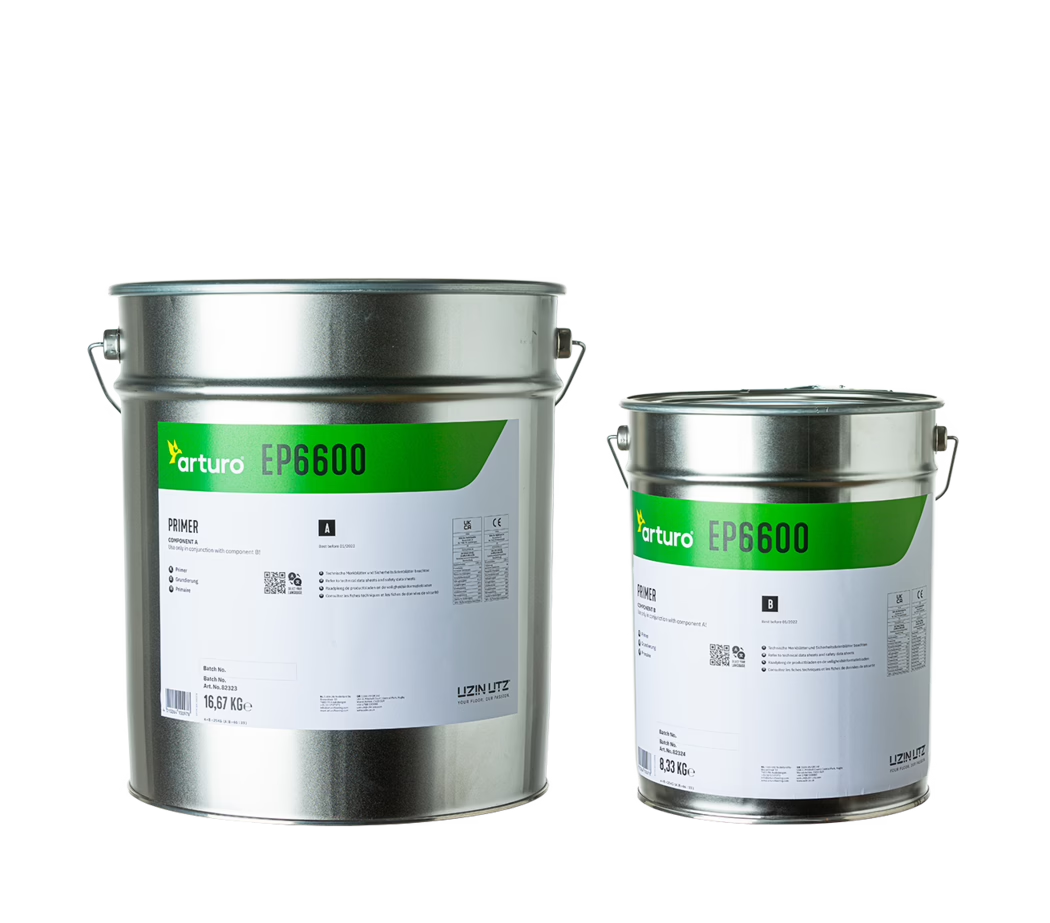
Arturo EP6600
Arturo EP6600 Primer is a 2-component, epoxy based primer. Also universally applicable as a scratch coat (2-C, EP)
Applications
The product is suitable as a primer on cement, anhydrite and magnesite bound subfloors. Arturo EP6600 Primer is especially suitable:
- As a primer under EP and PU self-smoothings.
- For manufacturing scratch coat (max.1:1 with Arturo sand, grain size 0.1 - 0.3 mm).
- As an adhesion layer, wet-in-wet under EP mortar.
Properties
- Easy to process
- Anti foam effect
- Good intermediate adhesion
- Universal use (as a primer as well as a scratch coat)
| Consumption |
Approx. 200 - 350 g/m² (as primer). Approx. 500 – 1300 g/m² (as scratch coat) depending on the subfloor |
|---|---|
| Mixing ratio |
66.7 part by weight comp. A 33.3 part by weight comp. B |
| Article number | Article | Packsize |
|---|---|---|
| 165106 | Arturo EP6600 Set 10kg | Set: A + B = 10 kg: A = 6.7 kg, B = 3.33 kg |
| 165105 | Arturo EP6600 Set 25kg | Set: A + B = 10 kg: A = 6.7 kg, B = 3.33 kg |


References
Frequently Asked Questions
EP6600 requires a sufficiently dry substrate, with substrate moisture below 75% relative humidity. Do not assume that an epoxy primer also provides damp-proof protection. Where moisture exceeds the permitted limit or a damp-proof membrane is required, contact our technical team to select the appropriate moisture-control system
Apply a closed, even layer using a rubber squeegee or a 14 mm pile nylon roller, using a brush around edges where needed. Ambient application temperature must be 15–30°C, with a minimum substrate temperature of 10°C and at least 3°C above the dew point. Maximum ambient relative humidity is 80%. Maintain the specified conditions during application and curing.
After mixing components A and B, add Arturo sand with a grain size of 0.1–0.3 mm, at a maximum 1:1 ratio by weight of mixed resin to sand. Mix thoroughly and apply an even layer with a smoothing trowel. Typical consumption is approximately 200–350 g/m² as a primer and 500–1,300 g/m² as a scratch coat, depending on the substrate. Follow the technical data sheet when estimating resin and aggregate quantities.
Sand broadcasting depends on the subsequent flooring layer and specified system. Where required, broadcast the fresh primer with 0.3–0.8 mm quartz sand. For levelling compounds, the technical instructions specify broadcasting to excess. Once cured, remove loose sand and check that the surface has consistent coverage before continuing. Follow the relevant system specification rather than treating every application identically.
